
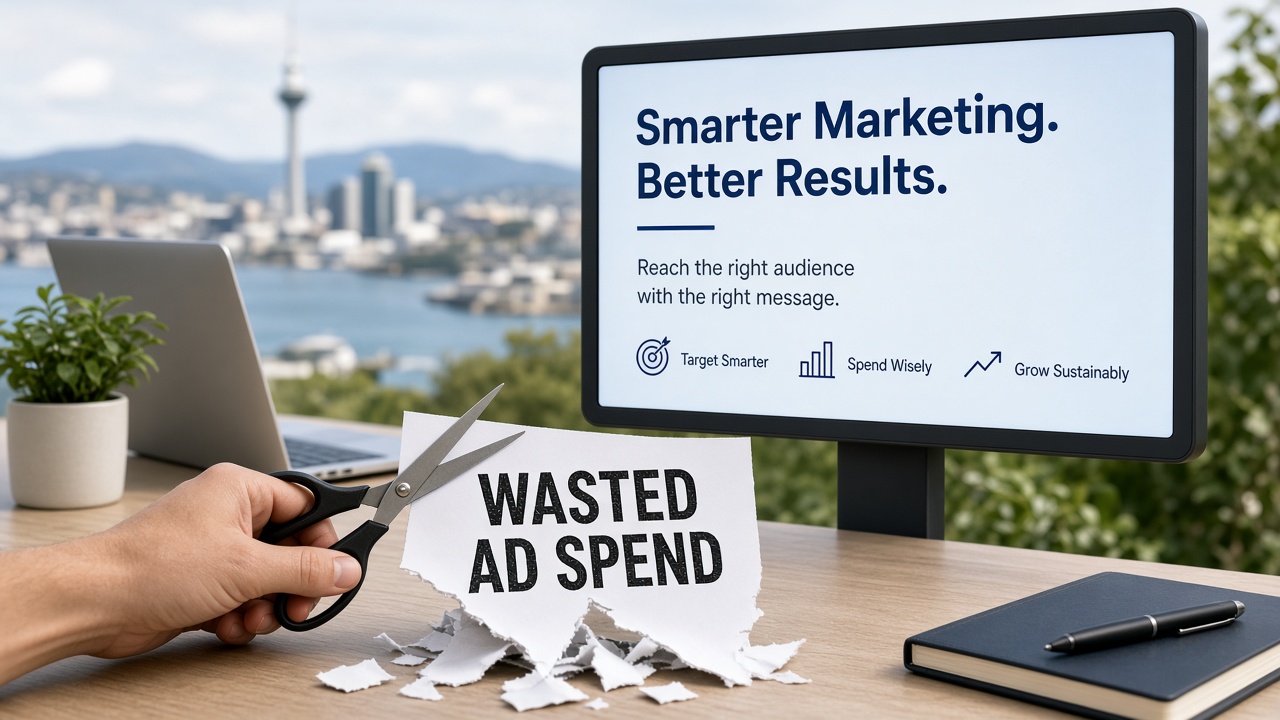
Marketing waste rarely arrives as a scandal. It arrives as a subscription you forgot, a boost that “keeps the page active”, an agency line nobody can explain, and a social campaign that looks busy while the till does not.
For New Zealand small businesses heading into 2027, unclear online ROI is the main reason those dollars survive. This guide is a step-by-step audit for Kiwi managers: review what you spend, trim underperforming social, and upgrade into high-frequency local outdoor screens as a transparent, high-visibility core asset, not another vague experiment.
Why Waste Hides in NZ Small-Business Marketing
In a small market, the same audiences get hit often. Costs creep up. Reports multiply. Attribution arguments replace decisions. Nobody wants to kill a channel “just in case”.
Waste thrives when:
- Activity is confused with outcomes
- Several tools claim the same enquiry
- Budgets renew automatically
- No one owns a monthly kill/keep call
- “Brand” is used as cover for unmeasured spend
Slashing waste is not anti-marketing. It is pro-clarity: keep what produces local customers, and stop funding what cannot prove it.
Step 1: Build the Full Spend Inventory
List every recurring marketing dollar for the last 90 days:
- Meta and social boosts and campaigns
- Google and search spend
- Agencies and freelancers
- Directories and listings
- Software (email, scheduling and “AI” add-ons)
- Sponsorships and print leftovers
- Outdoor or OOH, if any
If it renews, it enters the audit. Incomplete inventories are how leaks remain invisible.
Step 2: Attach One Business Outcome to Each Line
For each line, write one primary outcome:
- Qualified enquiries
- Bookings or sales
- Store visits
- Or “Unknown”
Unknown is not neutral. It is a trim-or-fix flag. Vanity metrics such as likes, reach and impressions alone can be secondary, but never the only defence for spend in 2027.
Intake discipline helps: train staff to ask “How did you hear about us?” and record the answers weekly. Imperfect human data beats perfect dashboards that disagree.
Step 3: Stress-Test Social Channels
Social is often the largest leak because it is easy to start and hard to admit has faded. Audit Facebook and Instagram-style activity with harsh questions:
- What is the cost per qualified local lead over 90 days?
- Is cold prospecting separated from warm retargeting?
- Is the audience limited to areas you actually serve?
- Is the creative refreshed, or running on zombie frequency?
- Are boosted posts being confused with structured campaigns?
Trim broad boosts, out-of-area traffic, and campaigns with rising cost and flat bookings. Keep proven converters with stable unit economics. Fix tracking, geography, offers and landing paths, then re-review in 30 days.
In NZ's small auctions, fatigue arrives early. Paying more to annoy the same locals is waste with better branding. For context, see Facebook and Instagram advertising for small business.
Step 4: Review Search, Site and “Silent” Retainers
Before you reinvest, make sure capture works:
- Can someone find your hours, phone and service area fast?
- Is your Google Business profile accurate?
- Do ads land on pages that convert this week?
- Which retainers would hurt revenue within 60 days if cancelled?
Tighten SEO and site hygiene so upgraded spend is not poured into a broken door. Keep selective Google Ads only where intent still pays. For channel mix context, read choosing marketing channels.
Directories and soft sponsorships: keep them if referral proof exists, and cut them if they are habit.
Step 5: Upgrade Into High-Frequency Local Outdoor
Money freed from waste should not automatically return to the same social account “to be safe”. Upgrade the core.
Position digital billboards as a transparent, high-visibility core marketing asset. Compare the traits:
- Online waste: unclear who saw what. Outdoor upgrade: a known site and corridor.
- Online waste: auction price drift. Outdoor upgrade: a period rate you can forecast.
- Online waste: easy to ignore or block. Outdoor upgrade: public roadside frequency.
- Online waste: soft local proof. Outdoor upgrade: catchment-fit presence.
High frequency means enough days in market for locals to recognise you, not a three-day vanity burst. Place on roads your customers drive and reject prestige faces outside your catchment. City primers: Auckland and Christchurch.
Creative stays simple: identity, one message and a local cue. Outdoor is accountable through visits, enquiries and intake answers, not click-through theatre. For format notes, see what billboard advertising is. For pricing context, read the billboard costs overview and confirm NZ rates.
Step 6: Install a Monthly Kill/Keep Ritual
Audits fail when they are annual theatre. For 2027:
- One named owner (a manager, not “the team”)
- One monthly 30-minute review
- Three options only: Kill, Fix or Keep
- A reinvestment rule: Kill dollars fund Fix priorities and the outdoor core first
Without a ritual, waste grows back like a weed.
One-Page 2027 Scorecard
For each line below, record whether the outcome is clear, whether the audience is local, whether the cost is justified, and your decision (Kill, Fix or Keep):
- Social cold
- Social warm
- Search
- Site, SEO and listings
- Retainers and tools
- Outdoor / DOOH
If Outdoor is blank because you never considered it while social waste is high, that blank is a finding.
Reinvestment Sequence (Do Not Skip)
- Fix capture (phone, website and listings)
- Kill proven waste
- Keep efficient intent channels
- Fund proximity digital outdoor as core visibility
- Re-audit next month
Pendulum swings, such as “delete all digital” or “never try outdoor”, create new waste. The upgrade is a deliberate substitution.
Frequently Asked Questions
How much budget should move after the audit?
Start with dollars attached to Kill items. That is the cleanest reallocation into outdoor or fixes, funding presence with money that was already failing.
What if attribution is still messy after outdoor launches?
Use business outcomes and intake questions over a full flight, compared to a baseline. Do not wait for perfect multi-touch models before deciding.
Should every NZ small business run billboards?
Only if customers are geographic and a relevant site exists. Purely remote businesses should cut waste differently. The audit still applies; the upgrade channel may differ.
How often should we repeat this framework?
Quarterly at minimum, and immediately after a spike in cost per enquiry or a drop in lead quality.
Final Thoughts
Slashing marketing waste in New Zealand is a management habit, not a motivational poster. Unclear online ROI lets weak social and fuzzy retainers drain 2027 cash while local customers still arrive through recognition, referrals and search.
Audit every dollar, trim what cannot prove local return, and upgrade into high-frequency outdoor screens you can explain in one sentence: this road, these dates, this creative, this catchment. That transparency is what makes digital billboards a core asset, and what stops waste from quietly renewing itself.
Media Mart helps Kiwi businesses reinvest with clarity through digital billboard advertising and outdoor advertising planned around catchment, creative and accountable growth.