
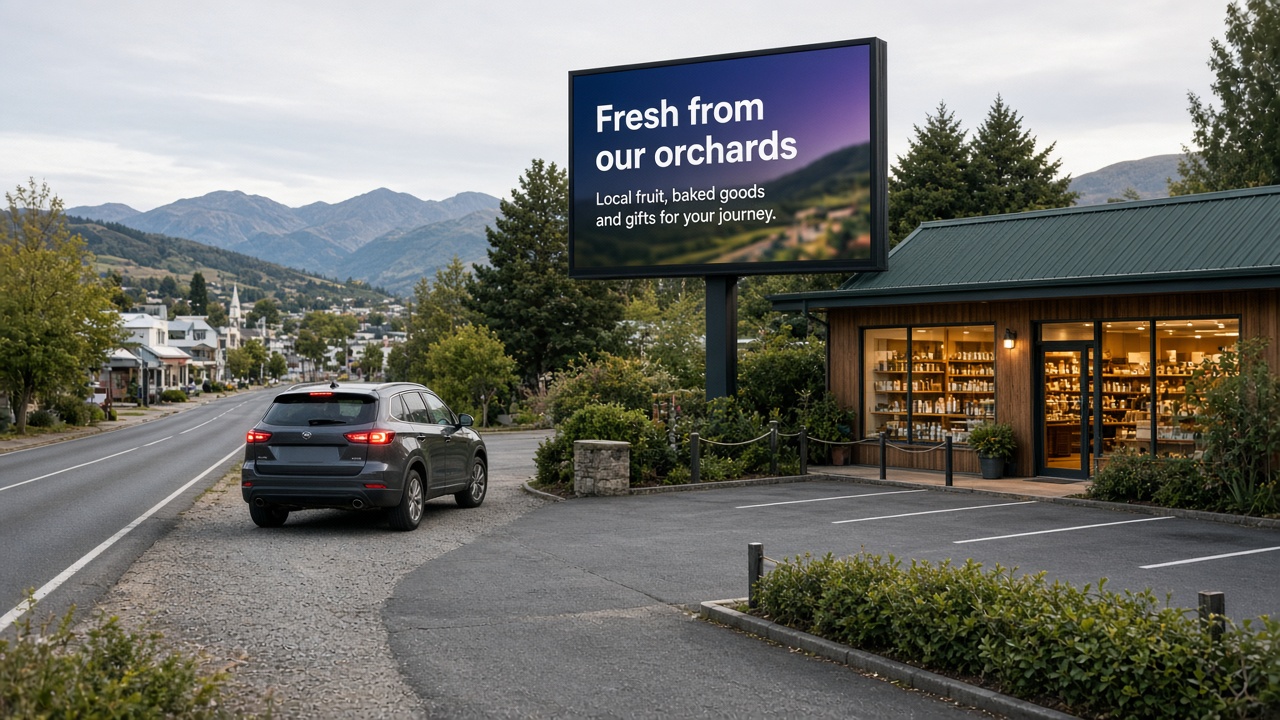
Ecommerce can put a parcel at the gate by tomorrow. It cannot recreate the first coffee of the day, a fitting that needs a mirror, or a same-day local service done face to face. Kiwi cafés, specialty stores and neighbourhood service hubs still win on experience, but only if drivers become walk-ins.
In 2026, that conversion is harder. People shop on phones between lights. Habits pull them to the same centre every week. Your competitors are one tap away. Survival is partly a roadside problem: can you divert a commuting driver from the through-lane into your door?
This tactical guide shows how directional and promotional digital outdoor screens turn driver impressions into visits.
The Survival Tension: Ecommerce vs the Physical Door
Online retail wins on convenience and comparison. Physical retail wins on immediacy, sensory proof and local relationships. Many NZ shoppers use both, researching on the phone and buying where it feels easy and trusted.
Your risk is not that ecommerce exists. It is that you never enter the trip. If the only time customers see you is in a feed, after they already planned their route, you are negotiating from behind.
Roadside digital exists earlier in the journey: on the approach, before the parking decision, while there is still time to divert.
Distracted Drivers Need Instant Meaning
Drivers give you a second, not a scroll session. Distraction is the default: navigation, kids, traffic and mental to-do lists. Creative that looks like a brochure fails. Creative that works like a road sign succeeds.
Design for glance comprehension:
- One brand mark, large
- One line of meaning
- One action or place cue
- High contrast and minimal clutter
If a passenger needs to read it aloud twice, it is too complex for the driver.
Who This Guide Is For
- Cafés and hospitality: morning commute and weekend destination traffic, with open-now and turn-in cues
- Specialty retail (gift, fashion, home, sport, bookshops): a reason to stop and centre cues
- Local service hubs (clinics, beauty, automotive, repairs): “near you” plus a clear category
The media principles are the same; the verbs differ: Eat, Shop, Book, Open.
Directional Billboard Design That Diverts
Directional outdoor answers one question: where do I go, relative to where I am? Strong patterns include:
- “Next left” or “This exit” when geography makes that true
- Centre or landmark names locals already use
- Suburb plus category (“Karori coffee”, “Riccarton bike fit”) when exit language does not fit
- An arrow or simple map cue, only if it stays huge and clean
Never invent a turn you cannot support. A wrong direction destroys trust faster than silence. Pair direction with identity, because a naked arrow without a known brand rarely converts strangers.
Promotional Screens That Still Convert at Speed
Promotions help when the offer is singular and time-honest:
- “Open late Thu”
- “Weekend tasting”
- “Same-day fittings”
- “Breakfast until 11”
Avoid stacked discounts, exclusions and tiny terms. Put conditions on the counter or the page. Digital helps you kill an expired promo without a reprint, which is useful when survival depends on truthful offers.
Format context: digital vs static billboards.
From Impression to Walk-In: The Conversion Chain
Driver conversion is a chain. Break one link and the board “didn't work”.
- See: the site is on the true approach road
- Get: the message is understood at speed
- Believe: the brand looks established enough to risk a stop
- Find: entry, signage and parking match the promise
- Receive: staff, stock and speed match the offer
Outdoor owns steps one to three. Operations own steps four and five. Brief both before you book.
City placement primers: Auckland and Christchurch.
A Tactical Weekly Rhythm for Retail DOOH
- Weekday AM: divert habits with open-now, coffee and service cues
- Weekday PM: win the after-work stop with late hours and pick-up cues
- Friday PM: set up weekend intent with Saturday opening or event cues
- Weekend: drive destination visits with a family or specialty reason
You do not need every slot. Pick the windows that match your till. Hold brand colours constant so recognition compounds across variants.
Measuring Driver-to-Door Without Fantasy Attribution
You will not get perfect click-ID data from a roadside LED. You can still run a retailer-grade test:
- Door or transaction counts versus prior equivalent weeks
- A promo code or verbal passphrase used only on the board
- A staff tally of “saw your sign/board”
- Spikes in directions and calls on flight dates
- Branded search lift
Judge over enough days for commute repetition. One wet Tuesday is anecdote, not a verdict.
Survival Mistakes to Avoid
- Booking a famous face your customers never drive
- Designing for desktop screenshots instead of asphalt
- Promoting products you cannot staff or stock
- Fighting ecommerce only on price
- Changing the brand look every week so nobody learns you
Survival is clarity, proximity and delivery, repeated.
For complementary channel sense, read choosing marketing channels. For cost planning, see the billboard costs overview and confirm NZ site rates.
Frequently Asked Questions
Can a small café afford digital roadside screens?
Often yes, at a single proximity face rather than a multi-city buy. Start where your regulars already drive, and measure door impact before scaling.
Should I put my Instagram handle on the board?
Only if it stays huge and secondary. Direction and visit reason beat social handles for walk-in conversion. Most drivers will not type mid-journey.
What if my store is inside a mall?
Advertise on approach roads to that centre and use mall-level cues. Your job is to get into the trip; wayfinding finishes inside.
Is this only for retail, not services?
Service hubs convert the same way when the action is “turn in”, “book today” or “open now”. The call to action changes; the glance rules do not.
Final Thoughts
The 2026 Kiwi retail survival guide is blunt: ecommerce owns convenience, so you must own the diversion. Distracted drivers will not study your catalogue on an LED. They will respond to directional clarity and one honest promotional hook, then to a door that delivers.
Use outdoor digital screens as conversion tools, not wallpaper. Design for the driver, place on the approach, and finish the job inside. That is how roadside impressions become walk-in customers.
Media Mart helps New Zealand cafés, retailers and local service hubs plan digital billboard campaigns built for diversion, catchment fit and visit growth.