
Tradies and local service businesses do not get to pause when prices rise. Parts, tools, freight and insurance climb; customers still want quotes yesterday; and three other vans in the same postcode are already advertising on every fence and feed.
The 2027 inflation cycle makes that squeeze sharper. You cannot always pass every cost on. You also cannot disappear from the market while competitors keep their names in front of homeowners and commercial site managers.
This article is for Australian trade services, mechanics and contractors who need steady local demand, and it explains how outdoor media, especially digital billboards, builds 24/7 authority in the hubs where your next job actually comes from.
Inflation Hits Trades Differently
A café can tweak a menu price overnight. A plumber, sparky, builder, landscaper or mechanic often quotes weeks ahead while supplier costs keep moving. Freight on materials, specialised tools and vehicle running costs all land before the invoice is paid.
That creates a simple commercial problem: you need enough booked work at healthy margins to absorb volatility. Discounting every job to “stay busy” digs a deeper hole. Winning the right local jobs, such as repeat clients, referral-friendly suburbs and commercial accounts, matters more than winning every price war.
Visibility is part of that defence. When homeowners and facilities managers already know your name, you spend less buying emergency leads at peak prices.
Local Competition Never Sleeps
Most trade markets are hyper-local. Customers rarely hire a contractor from the other side of the country. They hire someone who feels close, reliable and easy to recall when a hot water system fails or a fleet van needs service.
That is why competition feels intense even in a soft economy. The fight is not for Australia-wide attention. It is for dominance in a cluster of suburbs, industrial estates and commercial strips.
If your marketing only turns on when the phone goes quiet, you restart from zero each time. Competitors who stay present own the mental shortlist before the emergency call happens.
Why Outdoor Media Suits Tradies
Trade marketing needs to do two jobs at once: look established, and stay findable when someone is ready to book.
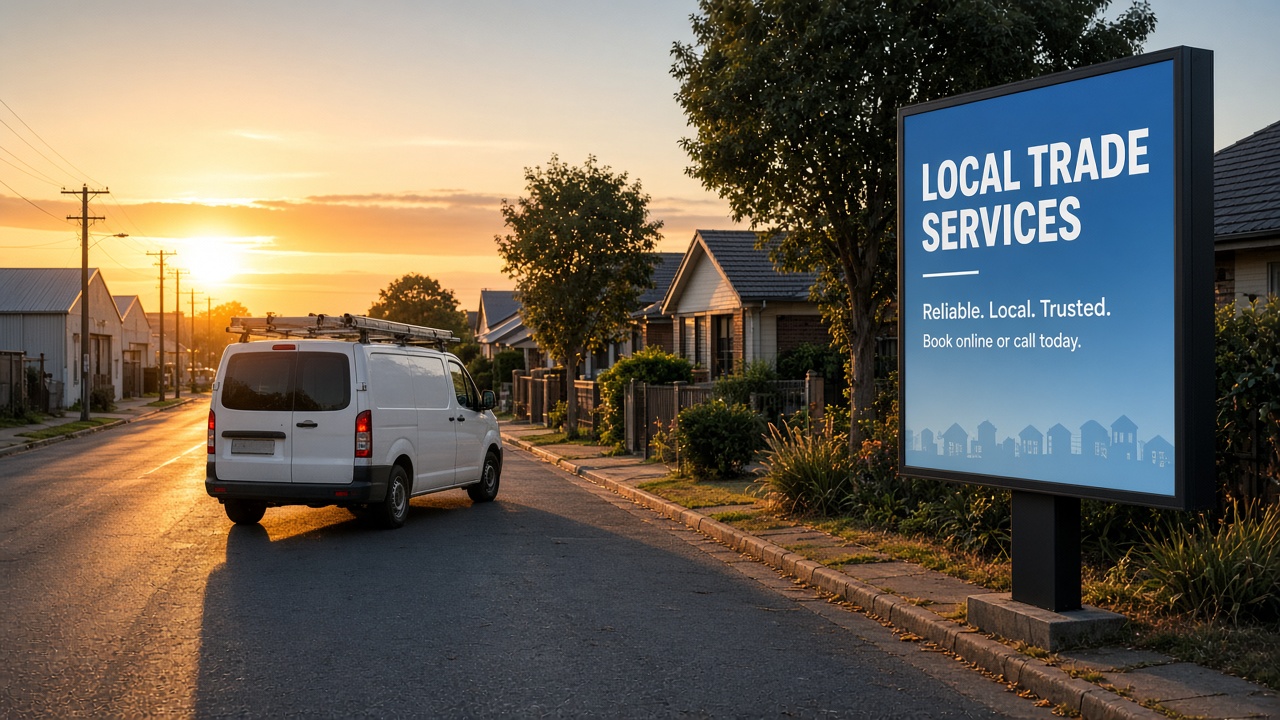
Outdoor media supports the first job in a way intermittent social boosts rarely can. A digital billboard on a residential arterial or near a commercial precinct puts your business name into daily travel. Mechanics benefit from boards on routes past industrial areas and suburban garages. Builders and contractors benefit near growth corridors and commercial hubs. Mobile trades benefit wherever their vans already work.
Unlike a letterbox drop that lasts a day, a well-placed screen keeps working morning, afternoon and weekend. It is the “always on” presence that signals you are a local operator, not a pop-up lead reseller.
Learn the format basics in what billboard advertising is and how it works and what out-of-home advertising is.
24/7 Authority on Digital Screens
Digital billboards give service businesses a practical kind of authority: your branding stays in market without reprinting corflutes every time a promo changes.
That 24/7 (or high-frequency scheduled) presence helps when:
- Homeowners drive past your catchment every weekday
- Commercial clients travel between sites and yards
- You want one strong brand line, then rotate a seasonal offer
Authority here does not mean looking corporate for its own sake. It means looking permanent. In trades, permanence reads as trust: insured, local, still here next month.
Day-parting can support trade rhythms: weekday creative for commercial decision-makers, weekend creative for home projects, wet-weather or summer-prep messages when relevant. Keep the brand block stable so recognition compounds.
Residential Hubs vs Commercial Hubs
Pick sites for the work you want more of.
Residential hubs suit home services such as plumbing, electrical, HVAC, pest control, cleaning, landscaping and roofing. Prioritise roads through family suburbs, near large centres and school corridors where household decision-makers travel.
Commercial and light-industrial hubs suit mechanics, fleet services, fabrication, civil and contractors chasing business accounts. Prioritise routes past industrial estates, logistics corridors and commercial parks.
Many businesses need both. A dual-creative plan on digital inventory, with one home-focused and one business-focused message, can cover two buyer types without two printed campaigns. Just keep each creative to one audience and one message.
Message Formulas That Work on the Road
Tradie boards fail when they read like a website footer. They work when a driver can get the point in a second.
Use a tight formula:
- Who: business name plus trade (for example local plumber, smash repair or builders)
- Where: suburb cluster or “Servicing [area]”
- What next: call, book, or a short offer line
Examples of direction (adapt to your brand):
- “Break down? Local mechanics - [Area]”
- “Licensed sparkies. Same-week bookings.”
- “Builders you see on site - not only online.”
Skip licence-number walls of text, tiny QR codes and five service bullets. Put proof and compliance on the van wrap, website and quote pack.
Scaling Without Buying Every Lead Platform
Lead marketplaces and heavy paid search can fill a diary, but inflation makes bought leads more expensive just when margins are under pressure. Outdoor does not replace a good Google Business Profile or a website that converts. It reduces how often you must buy the first introduction. If you do run search, Google Ads management can help keep spend focused on terms you can win profitably.
A scalable stack for 2027 looks like:
- Digital billboard presence in your true service radius
- Vans and job-site signage that match the board branding
- Fast phone and quote response
- Selective Google Ads on high-intent terms you can win profitably
- Referral prompts after every completed job
Scale comes from being the default local name, then letting search capture demand you already seeded on the road.
A Simple 90-Day Outdoor Plan for Trade Businesses
Days 1–15
Define the postcodes you profit from. Drop unprofitable fringe areas. Shortlist screens on those corridors.
Days 16–45
Launch a brand-authority creative (name, trade and area). Train staff to ask “How did you find us?”
Days 46–90
Add a second digital creative for a seasonal push or commercial offer. Compare booked-job volume and lead costs against the prior quarter, not against click dashboards alone.
Review supplier cost trends in the same window. Outdoor will not lower freight prices; it should improve the quality and steadiness of demand while you manage them.
Frequently Asked Questions
Is billboard advertising worth it for a one-van trade business?
It can be, if the site matches a tight catchment and your phone is answered quickly. Start with one proximity placement rather than city-wide coverage.
Should mechanics advertise differently from home trades?
Yes, in both placement and message. Mechanics lean into vehicle and industrial routes; home trades lean into residential arterials. Both still need a clear name and call to action.
Can I promote price-off deals during inflation?
Carefully. A limited, specific offer can spark calls. Constant discounting trains customers to wait. Many trades do better promoting speed, local trust and availability than a race to the bottom.
Do I need different boards for every suburb I service?
Usually no. One or two corridors that cover your profitable core beat scattered sites across every suburb on the van door list.
Final Thoughts
Beating the 2027 inflation cycle as a tradie or service business is not only about cutting costs. It is about protecting demand when tools, freight and competition all push against your margin.
Outdoor media, especially digital billboards in the residential and commercial hubs you actually serve, builds continuous local awareness. That 24/7 authority makes you easier to choose when the next job is ready to book.
Media Mart helps Australian trade and service businesses explore digital billboard advertising options in the suburbs and corridors that matter most to their work.